- Marvinsketch Chair Conformation
- Marvinsketch Online
- Marvinsketch Molecular 3d Alignment
- Marvinsketch Molecular 3d Alignment
MarvinSketch is a Java based chemical drawing tool. MarvinSketchallows you to create and edit molecules in various file formatsincluding MDL mol, Compressed mol, unique SMILES, SMARTS, Sybyl mol,PDB, CML, XYZ, POV-Ray.
MarvinSketch includes many advancedfeatures, such as recent structures (i.e. structure history), visualfragment placement, ambiguity reduction, and multi-level undo/redo.
The Marvin Applets are unique in the sense that they support allJava platforms, ranging from the ancient Java 1.0 to Swing. They workin older web browsers, but if they find themselves in a modernbrowser, they automatically utilize newer Java features.
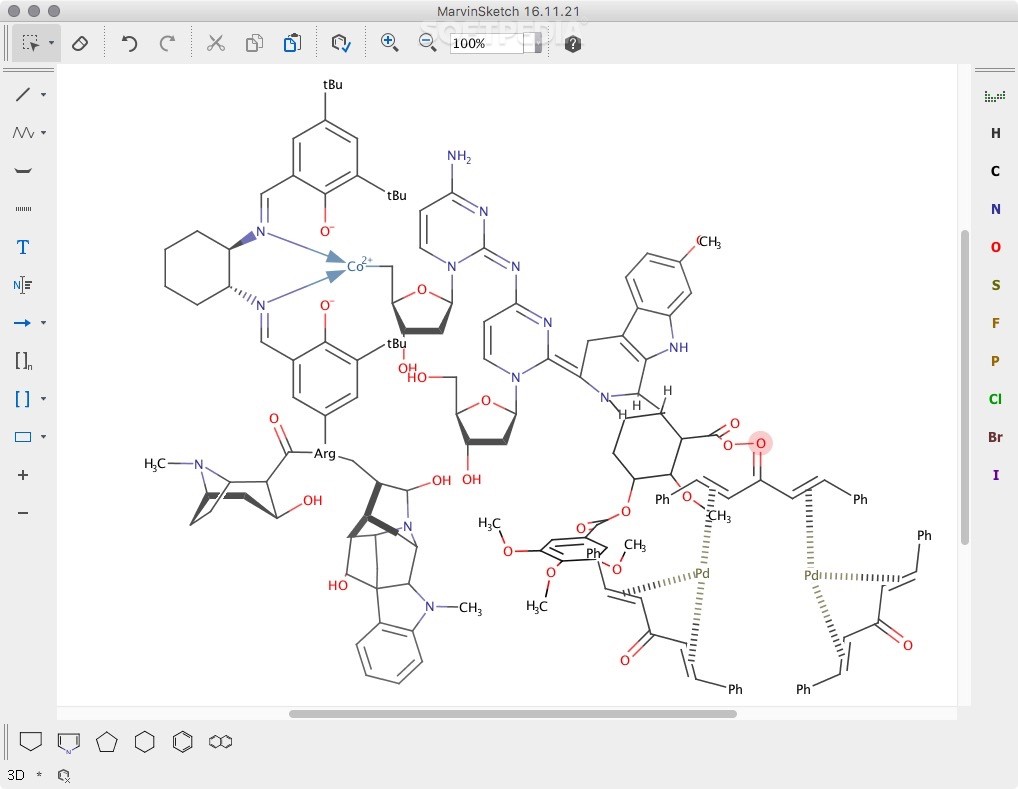
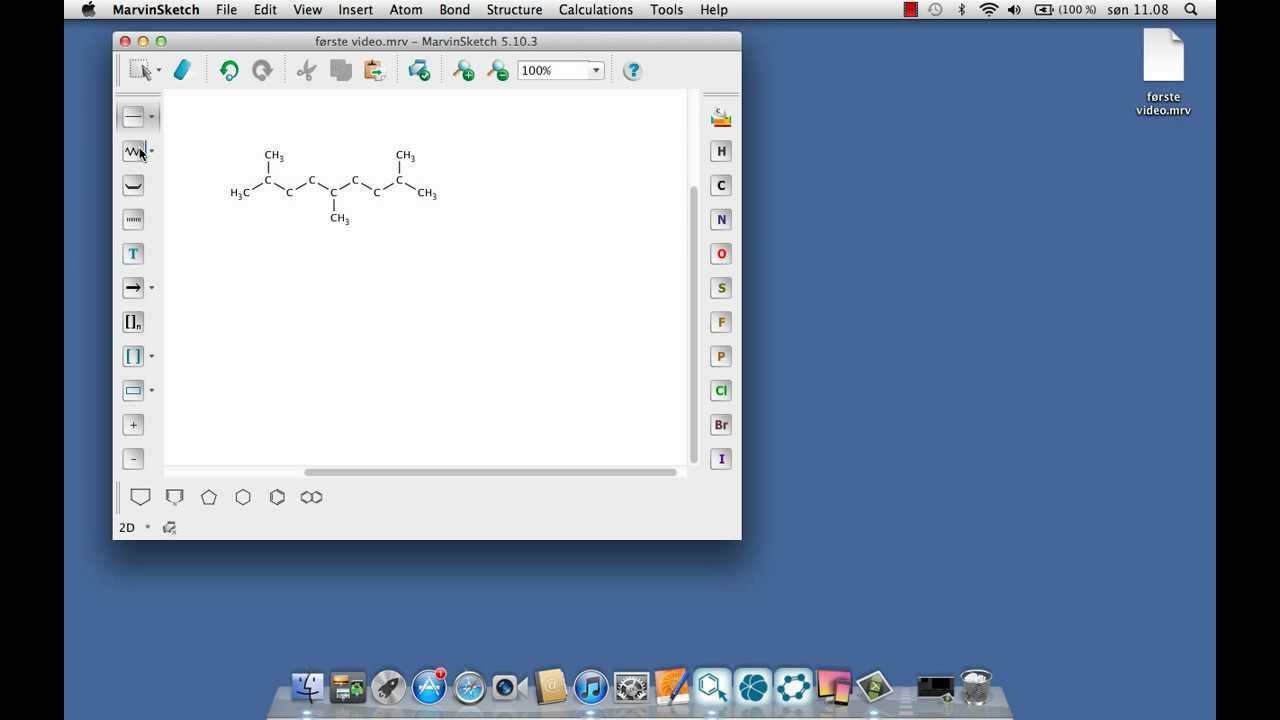
Below is an image of the MarvinSketch GUI, followed bydescriptions of each of the components
- This option can also be set on the Edit / Preferences / MarvinSketch panel. Specifies whether an end-user can customize the user interface. Setting this parameter to false disables the View/Customize dialog and the View/Configurations menu. Display quality.
- Download MarvinSketch - A chemical editor that will make it possible for anyone working in this field to create visual representations of reactions, queries and structures.
- MarvinSketch features an extensive set of functionalities to enable the fast and accurate drawing of chemical compounds, reactions, Markush structures and query molecules. Furthermore, MarvinSketch has built-in structure and valence checkers to provide guidance, and integrated property calculators to pull live results - upon your request.
Marvinsketch Chair Conformation
MarvinSketch allows users to quickly draw molecules through basic functions on the GUI and advanced functionalities such as sprout drawing, customizable shortcuts, abbreviated groups, default and user-defined templates and context-sensitive popup menus. LogP, LogS, and LogD 7.4 calculated using ChemAxon’s MarvinSketch Calculator Plugins. 1 N-(tert-butoxycarbonyl)-cystamine, N-(tert-butoxycarbonyl)-1,4-diaminobutane, N-(tert-butoxycarbonyl)-1,2-diaminoethane, and the PLAD disulfide linker were prepared as previously described.2.
Canvas
The canvas is the drawing area for graphically creating andediting structures. You can easily draw atoms, bonds, rings, arrows,and much more on the canvas using your mouse.
Toolbar
The toolbar contains a collection of buttons and icons to quicklyaid you in drawing molecular structures. The toolbar contains twotypes of buttons: click and toggle. Click buttons act as normalbuttons - performing an action when you click them. Toggle buttonshave multiple states that are alternated between with each mouseclick. The toolbar contains several toggle buttons, most relating todrawable elements such as bonds, templates (predefined structures),and arrows. When one of these buttons is selected, it sets thedrawing item associated with the mouse within the canvas.
Theimage below shows the different parts of the toolbar
Toolbar Elements | |
Little Periodic Table | The most important (frequently used) atoms have buttons on the toolbar. This part of the toolbar is referred to as the . It also includes charge buttons ('-' and '+'). |
Periodic Table (More) button | MarvinSketch contains a full periodic table to allow you to add any chemical element to your molecule. Clicking the button will open the Periodic table pop-up menu. |
Bond Button | The button allows you to select the bond type you wish to draw. Press and hold the bond button for a pop-up list of bond choices. |
Templates | MarvinSketch provides several predefined chemical structures, called templates (e.g., cyclopenthane, cyclohexan, benzene). |
Clicking on the button allows you to draw a Reaction arrow within the molecule. | |
MarvinSketch provides the following familiar editing functionality in the Toolbar: and . To use the cut or copy functionality, you must first select part of the molecule. To paste cut/copied structures, click on , then click the canvas where you would like to place the structure. | |
Zoom Buttons | The buttons allow you to zoom in and out, and to fit the molecule to the current size of the window. |
Help Button | Opens the Help document. |
AWT-Only Buttons
The AWT applet functions a little differently than the Swingapplet and application. Its toolbar contains three AWT-specificbuttons to manipulate the toolbar and access the Menu.
- The button allows you to launch the Sketcher in a new window, allowing access to the Menu Bar. If the Sketcher is already in a separate window, this button returns it to the original location.
- The button moves the Toolbar to the left of the canvas and orients it vertically.
- The button toggles the visibility of the Toolbar.
Menu Bar
In addition to the features availablethrough the toolbar, MarvinSketch has several features that can beaccessed via the Menu bar.
N.B. In the AWT version of Marvin, theMenu bar is not initially visible. To access the Menu bar, click the button (labeled with an arrow pointing upward and located to the left of thetoolbar), which will launch the Sketcher in a new window with a visible Menubar.
Menus and Major Submenus | |
File Menu | The File menu contains the available file operations, such as . The (unsigned) Swing and AWT applets contain only a subset of these functions. |
Edit Menu | The Edit menu contains general editing functionality (i.e. and ) as well as Marvin-specific editing options. |
Groups Submenu | The submenu contains the tools for creating and working with abbreviated groups (S-groups). |
Edit Source | Choosing from the menu opens the Edit Source window. The Edit Source window opens the file for the current molecule as text. You can view and edit the molecule file in any of the supported formats (SMILES, molfile, XYZ, etc). |
| Preferences | The See Saving Display Options. |
View Menu | The menu allows you to alter the way the molecule is displayed without altering the molecule itself. You can change the molecule display type, background color, color scheme, error highlighting, etc. |
Hydrogens Submenu | The submenu controls the display of implicit and explicit hydrogen atoms in the molecule. |
The menu contains a list of available template groups. By default, the template list is displayed in the Templates panel of the toolbar. The Ring templates group contains a collection of different types of rings. It can also be displayed in the toolbar by selecting the choice. The Amino Acids and Polycyclic template list includes too many templates to fit in the toolbar, so they are displayed in a pop-up window when you choose them. | |
Tools | See Calculator Plug-ins |
Help | Select the menu item to access this help document. |
Pop-up Menus
There are four pop-up menus in MarvinSketch. When you right click onthe canvas, a menu will appear based on the position of the mouse.The following table summarizes these menus:
Mouse Location | Associated Right-Click Menu |
|---|---|
Atom | Atom Pop-up Menu |
R-group | R-group Pop-up Menu (Modified Atom menu) |
Bond | Bond Pop-up Menu |
Open canvas space | Edit Pop-up Menu |
Atom Pop-up Menu
The Atom pop-up menu appears when you right-click on an atom onthe canvas. It contains options for atom-specific activities.
Menu Item | Description |
Charge | Applies a charge between [-9,9] to the atom. This submenu is not dynamically generated, so Marvin will let you set any of these values on any atom, highlighting the Valence Errors in red upon completion. In other words, Marvin will allow you to set a charge of -5 on hydrogen, despite the fact that this is chemically impossible. |
Radical | Sets the selected atom as a radical. You can select the type of radical - monovalent, divalent, divalent singlet, or divalent triplet. The Off option removes the radical designation. |
Isotope | The submenu contains a list of the isotopes of the selected element, dynamically generated based on the selected atom. Select an isotope to set or change the isotope number or choose to remove the the isotope number. |
Map | The submenu contains a list of available map identifiers that can be set on each atom. Map labels are useful because they remain constant, unlike atom indexes, which can change as the molecule is altered. Another common use is to mark atoms in reactions. An advantage of Map labels is that they can be saved into SMILES and MDL format. |
R-Group | Gives a submenu of R-group labels to change the selected atom to an R-group label. |
Branch | Adds a new bond with implicit hydrogen to the selected atom. This option is disabled for atoms that can have no more bonds. |
Remove | Removes the selected atom from the molecule. |
R-group Pop-up Menu
The R-group pop-up menu appears whenyou right-click on an atom labeled as an R-group.
Menu Item | Description |
Map | Map numbers are user defined atom identifiers. They are commonly used in reaction equations marking atoms taking part in the reaction. Maps are also useful in complex chemical expressions referring to atoms of certain functional groups. |
R-Group | Gives a submenu of R-group label choices, Build Markush structures or R-group queries using the R-group labels. R-groups symbolise alternative substituents. |
Remove | Removes the selected atom from the molecule. |
Bond Pop-up Menu
The bond pop-up menu appears when you right-click on a bond withinthe molecule. It allows you to make a number of changes to theselected bond.
Menu Item | Submenu Items | Description |
Bond Type Radio Buttons | Single | Changes the selected bond type to Single |
Double | Changes the selected bond type to Double | |
Triple | Changes the selected bond type to Triple | |
Aromatic | Changes the selected bond type to Aromatic | |
More | Query bond types | Changes the selected bond to a bond type (Single Up, Single Down, Single Up or Down, Double Cis or Trans, Double C/T or Unspec, Single or Double, Single or Aromatic, Double or Aromatic, Any) for use in a query. |
Attributes | Stereo Search | Uses stereoconfiguration of specified double bond when this molecule is used as a query. |
In Ring | Sets a bond property so that when the molecule is used as a query, the specified bond must be in a ring to score a hit. | |
In Chain | Sets a bond property so that when the molecule is used as a query, the specified bond must be in a chain to score a hit. | |
Align | Vertical | Orients the bond vertically |
Horizontal | Orients the bond horizontally | |
Remove | Removes the selected bond from the molecule |
Edit Pop-up Menu
The Edit pop-up menu appears when you right-click on open canvasspace (i.e. not on an atom or bond). This menu has two differentstates, corresponding to selection mode being turned on or off. Editpop-up menu items include:
Marvinsketch Online
Enabled when Selection Mode is | |||
Menu Item | Description | ON | OFF |
Recent | The submenu contains a list of atoms and templates previously placed on the canvas. It does not include recently used bonds. You can change the drawing object by selecting one of the items in this list. | X | X |
Copy | Puts a copy of the selected object on the clipboard. | X | |
Copy as SMILES | Puts a copy of the selected object on the clipboard in SMILES format. | X | |
Cut | Puts the selected object on the clipboard and removes it from the canvas. | X | |
Paste | Sets the drawing object to the item on the clipboard. | X | X |
Select All | Quickly selects the entire molecule. | X | X |
Create Group | Creates an abbreviated Group from the selected substructure. See the S-Groups section for more information on creating and using Groups. | X | |
Map Atoms | Maps selected atoms with unique map numbers. | X | |
Flip | Flips the structure on the canvas. The submenu allows you to choose horizontally or vertically. | X | X |
Attributes | Edits structure attributes. | X | X |
Sends the molecule to the printer. | X | X | |
Marvinsketch Molecular 3d Alignment

Marvinsketch Molecular 3d Alignment
Copyright © 1998-2004ChemAxon Ltd.