Jun 17, 2015 openssl and tokenizer php extensions are included in php-common.x8664 package, you have to launch this command $ yum install php-common.x86 64 php-mbstring.x86 64. Yum install php-soap. I am not sure that your Class 'SoapClient' error is caused by the lack of the extension in any case, that looks more like some php.
∟Managing PHP Engine and Modules on CentOS
∟Install PHP Extensions on CentOS
This section provides a tutorial example on how to add PHP extensions on CentOS Linux systems by searching and installing the extension using the 'dnf' package manager.
PHP has many extensions. Some of them are pre-installed and some are not.If you are getting errors like 'Class .. not found', or 'Call to undefined function ..',you need to install the extension that provides the missing class or function.
For example, when I test a new Web application on my CentOS system, I see this error. I know that I need to install the ZIP extension.
To fix the problem, I check what PHP extensions have been installed on the system first:
There is no ZIP related extensions installed yet. So I search for PHP extensions:
I see that 'php-pecl-zip' is available for my system. So I install it:
Now re-run the Web application. The 'ZipArchive' error is gone!
Table of Contents
About This Book
Install Openssl Php Extension Centos Server
Introduction and Installation of PHP 7.3
PHP Script File Syntax
PHP Data Types and Data Literals
Variables, References, and Constants
Expressions, Operations and Type Conversions
Conditional Statements - 'if' and 'switch'
Loop Statements - 'while', 'for', and 'do .. while'
Function Declaration, Arguments, and Return Values
Arrays - Ordered Maps
Interface with Operating System
Introduction of Class and Object
Integrating PHP with Apache Web Server
Retrieving Information from HTTP Requests
Creating and Managing Sessions in PHP Scripts
Sending and Receiving Cookies in PHP Scripts
Controlling HTTP Response Header Lines in PHP Scripts
Managing File Upload
MySQL Server Connection and Access Functions
Functions to Manage Directories, Files and Images
SOAP Extension Function and Calling Web Services Explain everything download mac.
SOAP Server Functions and Examples
Localization Overview of Web Applications
Using Non-ASCII Characters in HTML Documents
Using Non-ASCII Characters as PHP Script String Literals
Receiving Non-ASCII Characters from Input Forms
'mbstring' Extension and Non-ASCII Encoding Management
Managing Non-ASCII Character Strings with MySQL Servers
Parsing and Managing HTML Documents
Install Openssl Php Extension Centos Server 2016
Configuring and Sending out Emails
Image and Picture Processing
Managing ZIP Archive Files
Managing PHP Engine and Modules on macOS
►Managing PHP Engine and Modules on CentOS
PHP Version Pre-Installed on CentOS
►Install PHP Extensions on CentOS
PHP Version Pre-Installed on CentOS 6
Use PHP Composer on CentOS Computers
Outdated Tutorials
References
Full Version in PDF/EPUB
PHP modules, or extensions, can greatly extend the core functionality of PHP. These modules are compiled libraries that can help you implement different methods to connect to other services without the need to 'reinvent the wheel.' By enabling these modules, your PHP code can become more versatile and adaptable, allowing you to interact with things such as MySQL seamlessly. The focus of this article is to explain how you can enable these modules in a CentOS 7 server so that you can take your PHP code to the next level. This article implies that you have already installed PHP on your CentOS 7 server. However, if you have not done this yet, please look at our article: How to install PHP (CentOS 7).
How To Install PHP Modules In CentOS 7
Before getting started, you'll need to log in to your server using SSH. If you're not familiar with how to do this, or you find yourself really enjoying our articles, please take a moment and read through the following: Connecting to Your Server via SSH. Once you have connected to your server via SSH, you can move on with the installation. Like any other installable software in CentOS 7, you'll be installing PHP modules using the 'yum' package manager. The basic syntax to install modules is identical to installing other packages. Essentially it would be yum install. But what if you're not sure what PHP modules you'd like to install? By using Yum, you can actually perform a search for different packages, in this case, PHP modules like so:
This will search for anything with 'PHP-' in its name and display a list of matching packages on your monitor. This tells you what packages are available, but what if you need to know what they do? In this instance, you can either put your 'Google-fu' to work, or you can use the yum info command with the following syntax:
For example, let's pretend that you want to know more about the PHP-CLI module, you'd issue the following:
This would generate output similar to the following:
As you can see, the test server that I am using already have this module installed. However, if I needed to install it, I would do so via the following command:
You can, of course install multiple modules at once by using the following syntax:
A practical example of this would be:
Install Openssl Php Extension Centos Server Download
How To View Current PHP Modules
When logged into your server via SSH, type in the following command
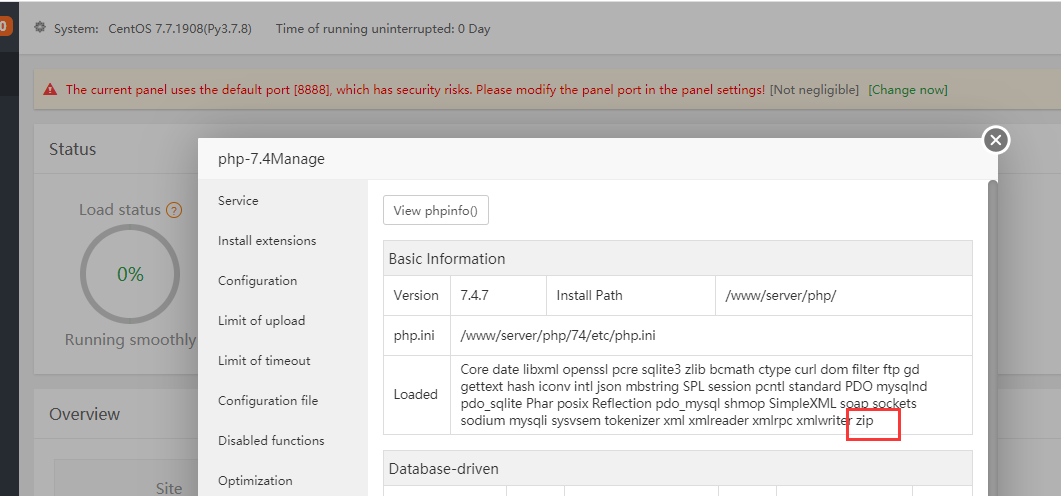
This will populate a list, like the following, showing you all the current PHP modules installed.
Install Openssl Php Extension Centos 7
Repository information has been removed from the above example
How To Remove A PHP Module
After installing any PHP module, you, of course, will have the opportunity to delete them. To delete a PHP module, type the following command
Install Openssl Php Extension Centos Server Download
You can remove multiple PHP modules by typing all the names you wish to remove, for example:
A list of PHP modules will be listed for removal, and typing these commands will require a [Y/N] (yes or no) response via a prompt to complete in the end.
Now your PHP modules chosen to be removed are uninstalled.
Php Extension Downloads
Like most things, moderation is the key, and it is best only to install modules that you need. I hope that after reading this article, you now feel more comfortable installing PHP modules. If you're interested in testing your server's PHP processing, we have an article that you might enjoy, which covers that: How To Create A PHP Info Page.