The AWS has launched AWS Command Line Interface (CLI) unified tool to manage your whole AWS services from the command line and automate them through scripts.
AWS provides set of command line tools, to give administrators and developers access to manage their own AWS services using local clients beside management console access AWS CLI v2 Setup In the following steps we will go through how to setup and configure AWS CLI to connect to your AWS account and manage your services. Firstly, for Auto Scaling we must install some command-line tools. This is done to minimize your usage of billable services. The Amazon EC2 command-line interface tools (also called the EC2 CLI tools) wrap the Amazon EC2 API actions. These tools are written in Java and include shell scripts for both Windows and Linux, OS X, or Unix. Dec 09, 2014 The Amazon Web Services command line tool (AWS CLI) gives users the ability to control and manage AWS services through command line scripts. This makes everything very easy to manage with a single tool, and it can be installed on any Linux distribution. The tool requires Python in order to run, so that’s really the only prerequisite. AWS CLI is used to monitor and manage AWS services and features. Let's understand how to install AWS CLI, along with it's configuration and uninstallation. AWS: CLI (Command Line Interface).
You can install AWS CLI on your Linux or Windows machine for managing AWS services from command line.
In this post I have demonstrated how to install and configure the AWS CLI tool and its prerequisite in CentOS Linux. For using AWS CLI on my base Ubuntu 16.04 machine I have made a one CentOS 7 Virtual Machine by using KVM Virtualisation.
On below Python versions AWS CLI can work:
- 2.6.5 and greater
- 2.7.x and greater
- 3.3.x and greater
- 3.4.x and greater
- 3.5.x and greater
- 3.6.x and greater
PIP Package checking and installation before installing AWS CLI:
For installing AWS CLI PIP Package should be installed in your Linux machine. PIP is a special program used to install Python packages to your system. Pip is sometimes included automatically when Python is installed to your system, and sometimes you have to install it yourself. As AWS CLI package is Python based hence PIP package is a mandatory prerequisite package which should be available in your Linux machine
- To check if Python PIP is installed in CentOS 7 VM type command pip –version:
- If PIP package is not installed in Linux machine then PIP Package need to download from Link: https://bootstrap.pypa.io/get-pip.py and install:
Installation of AWS CLI:
- Install the AWS CLI package from PIP.
- Post installation check the AWS CLI version:
Aws Command Line Tools Glacier
Configuration of AWS CLI:
- Open the IAM console.
- In the navigation pane of the console, choose Users.
- Choose your IAM user name (not the check box).
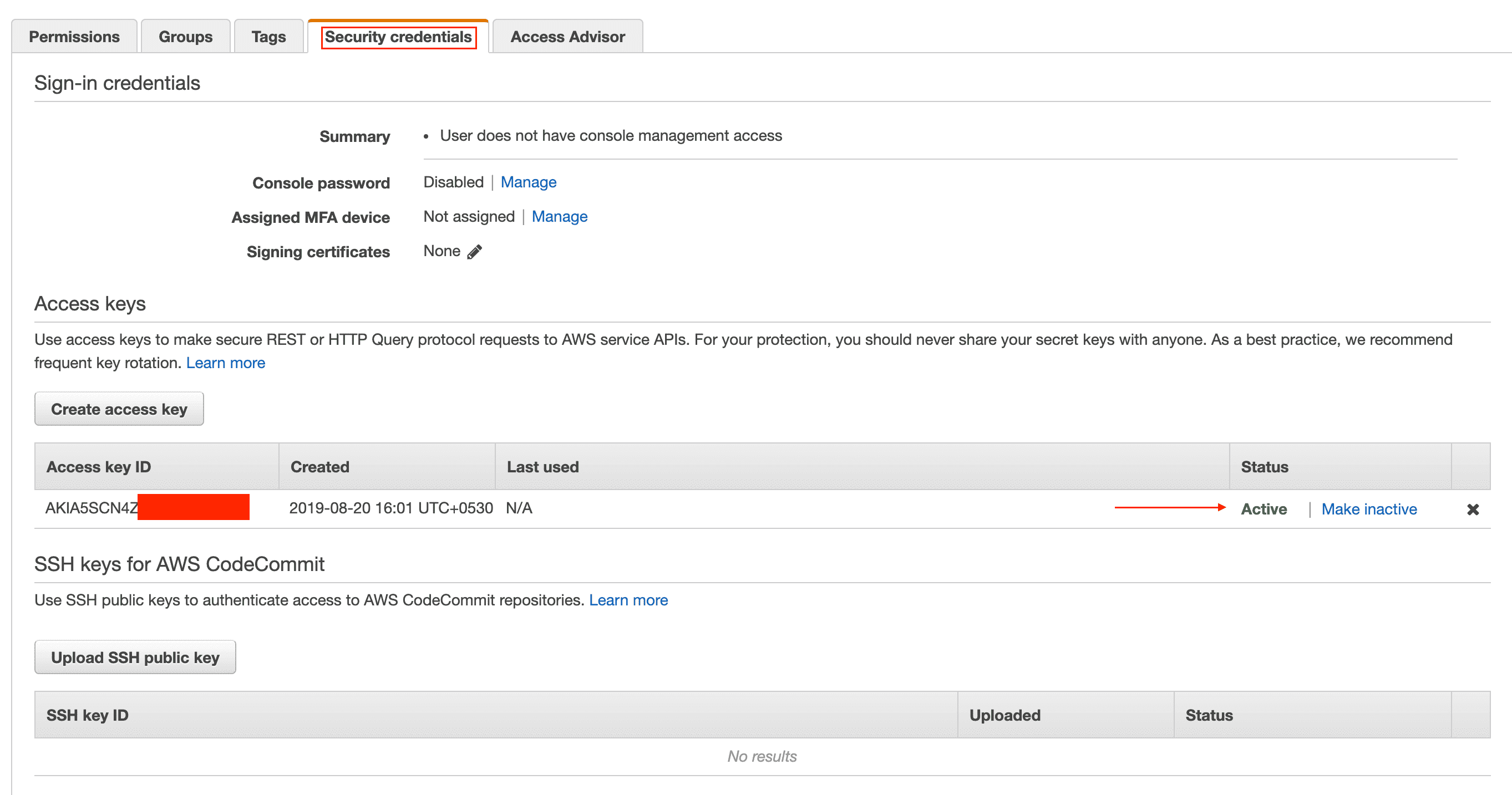
- Choose the Security credentials tab and then choose Create access key.
- To see the new access key, choose Show. Your credentials will look something like this:
- Access key ID: AKIAIOSFODNN7EXAMPLE
- Secret access key: wJalrXUtnFEMI/K7MDENG/bPxRfiCYEXAMPLEKEY
- To download the key pair, choose Download .csv file. Store the keys in a secure location.
- Configure the AWS connection with same Access Key ID and Secret Access Key.
- Now do post configuration check with command: aws ec2 describe-instances –output table
11,606 total views, 5 views today
Introduction to the AWS Command Line Interface (CLI)
Video: .mp4 (1280x720, 30 fps(r)) | Audio: aac, 48000 Hz, 2ch | Size: 1.19 GB
Genre: eLearning Video | Duration: 41 lectures (6 hour, 20 mins) | Language: English
Use the Command Line to Deploy/Modify/Manage/Automate infrastructure on AWS
What you'll learn
Use the Command Line Interface to deploy AWS resources
Setup multiple Profiles with Multiple Access Keys to quickly switch between permissions or accounts
Automatically Sync local files to S3 at specified time.
Create and invoke Lambda Functions using the command line
Build a VPC using the command line
Deploy Cloudformation templates to create Stacks with AWS CLI
Deploy EC2 instances and create a custom dashboard to view running instances on the command line.
Create IAM users, access keys , roles using the command line
Requirements
AWS Account
Experience with AWS
Description
--- Recent Updates---
- AWS S3 Server Side Encryption lessons added. This included SSE-S3, SSE-KMS and SSE-C( not available via the AWS console)
- AWS KMS key creating with the CLI
- S3 Multipart upload with the AWS CLI
- Use CLI to work with Amazon Rekognition ( for image recognition and video analysis)
About the Course:
This course is designed to help students and developers get started with using AWS Command Line Interface.(CLI). If your prior experience with AWS has solely been AWS' web console, using the CLI is a different way of using your AWS account. Using the command line interface is a critical skill for any AWS professional.
The AWS Command Line Interface (CLI) is a unified tool to manage your AWS services. With just one tool to download скачать and configure, you can control multiple AWS services from the command line and automate your infrastructure through scripts.
You should be ready to manage and automate your AWS infrastructure using the CLI after this course. You will learn 1 more way to deploy/manage/destroy infrastructure and services on AWS. This will make your workflow much more faster and efficient.
Learning the command line will give you another perspective on the AWS services and may even shed light on concepts that you are unclear with. The AWS developer associate exam objective mentions ' Ability to use the AWS service APIs, AWS Command Line Interface (CLI), and software developer kits (SDKs) to write applications' Learning the command line is one of the big aspects of the AWS DevOps Pro exam as well.
In this course , We will go over things like:
Create access keys to use with the AWS CLI
Install and setup the CLI on your local machine
Create a VPC with the CLI.
Create EC2 instance, view running instances, filter attributes.
Copy files to and from S3 buckets. Sync local folders with automated cron jobs.
Create lambda functions and invoke them using CLI
Deploy CloudFormation stacks with the CLI
After this course you can begin making calls to your AWS services from the command line like:
$aws ec2 describe-instances
$aws s3 ls
$aws s3 sync . s3://mybucketname
$ aws ec2 stop-instances -instance-ids i-123abcdefg
and more advanced things like creating Lambda functions, creating CloudFormation stacks etc.
What you will get with this course:
A catalog of videos/labs on how to use the AWS CLI
Future updates on various new topics
Ability to ask questions on the Discussion board
If you have any request for a certain topic, please share them in the discussion section.
Saurav Sharma

Who this course is for:
Those who want to use the command line to deploy infrastructure on AWS.
Those preparing for AWS certification exams
Those who want to automate deployment and management AWS resources.
Aws Command Line Tools
download скачать link:
Aws Command Line Tool Mac
Aws Command Line Tool
Links are Interchangeable - No Password - Single Extraction