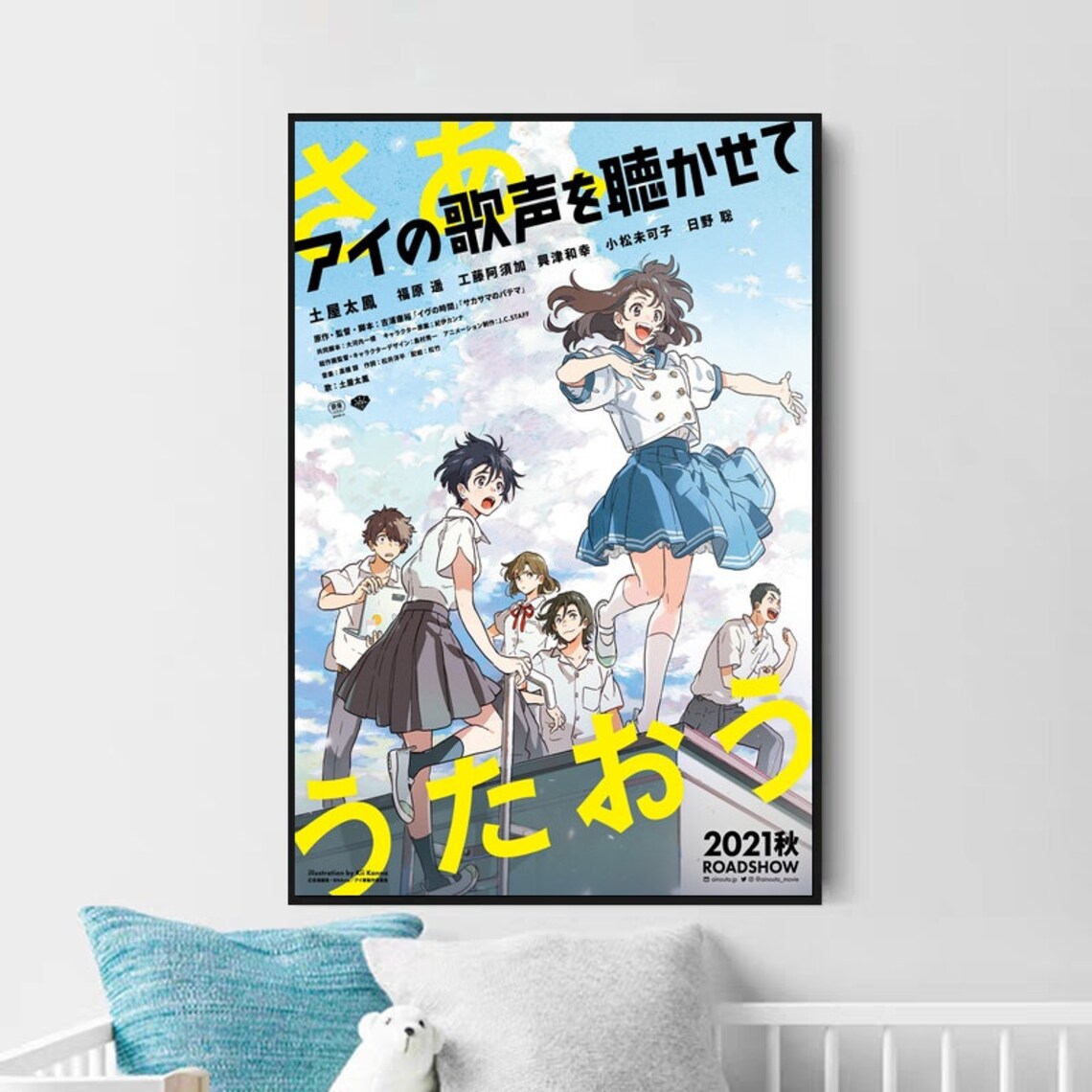
Utagoe’s musical repertoire also gave rise to utagoe kissa (“singing voice coffeehouse”), drink-and-sing establishments by which the term utagoe is remembered today. Among the “first-generation” utagoe kissa in Shinjuku, Tokyo, Tomoshibi (“Lamplight”) is the only surviving first-generation utagoe kissa through a branch location. The official website for the upcoming original anime film Ai no Utagoe wo Kikasete (Sing a Bit of Harmony) has posted a 30-second second teaser trailer introducing its main characters. Macross 30: Ginga o Tsunagu UtagoeIn 2013, the Macross franchise will celebrate its 30th anniversary. From the first songstress Lynn Minmei to the latest stars such as Sheryl Nome and Ranka Lee are all going to join this celebration. The director Kawamori Shouji weaves a brand new plot to include the full cast of jet pilots, valkyries and ladies. The game takes places on a planet with unstable. Macross 30: The Voice that Connects the Galaxy (マクロス30 銀河を繋ぐ歌声, Makurosu 30: Ginga Eo Ysunagu Utagoe), also known as Voices Across The Galaxy, is an Action Role Playing Game for the PlayStation 3 and was developed by Artdink and published by BANDAI NAMCO Entertainment.1 The game is part of the 'Macross 30th Anniversary Project' of the Macross franchise, featuring. Utagoe is a member of Vimeo, the home for high quality videos and the people who love them.

The Central Intelligence Agency’s (CIA) efforts to purge sites of communism was a global operation—and Japan was no exception. Key officials from the agency described acts of espionage and strategic coordination in the 1950s and ’60s that ranged from the mobilization of controlled media and Yakuza mafia groups, to the violent suppression of socialist movements.[1] With its title alluding to mind-body dualism, this exhibition contends with past machinations that are still corporeally present, albeit camouflaged in other forms of manipulation and continuing to shift control and coerce power under new terms.
Tracing the journey of the renowned labor anthem The Red Flag sung to the tune of the German folk song O Tannenbaum,Minouk Lim (b.1968, South Korea) suggests how this evocative and emblematic anthem became a vessel for otherwise conflicting beliefs. In this newly commissioned work, Lim extends her research to the transformation of the Japanese Utagoe, or singing voice, movement—socialist choral activities that strove to promote popular unity.[2] Exhibited as a video and sound installation of the documented performance, Lim’s work stages a car broadcasting live accordion music of Soviet workers’ songs while driving around the Tokyo Imperial Palace, as such choreographing the deterritorialization of history via the subject in motion. The intervention also recalls Bloody May Day in 1952,[3] when protesters clashed with police forces amidst unified chanting of proletariat hymns.
Known for his appropriation of popular culture and cinematic decoding of heteronormative scripts, Ming Wong (b.1971, Singapore) develops a new project on Japanese soft porn, known as “pink films.” Wong's ongoing research on the Nikkatsu Roman Porno probes the process of pornification in the Japanese film industry during the 1970s.[4] His investigation touches on a generation of avant-garde filmmakers who began their careers in this genre in order to support themselves, while being engaged in furtive activist groups. From the epics of abrasive left-wing ultra-radicality to those of dirty, misogynist fantasies, the filmmakers incorporated their creative license to vent their frustrations and induce an aestheticized arousal of minds and loins for the market.
The CIA's covert relationship with Italy’s Christian Democrats, which mirrors their veiled involvement with the Japanese Yakuza, supposedly lead to the assassination of Italian filmmaker Pier Paolo Pasolini (1922-1975). Ostia (2013), a video work by Yoshua Okón (b.1970, Mexico) depicts this imagined crime scene. On the other hand, Okón’s Salò Island (2013) is a video and sculpture installation indicative of a sadistic and tortuous scene from Pasolini’s film Salo, or the 120 Days of Sodom (1975). Situated in “a surreal late-night corporate labyrinth” in Newport, California, the characters reappear as desolate beings bereft of sentient life. It metaphorically infers the past and the future, and echoes how neoliberal capitalism salutes a reloaded fascism.
The Imperial Ghost in the Neoliberal Machine (Figuring the CIA) features works reacting to anti-communist rhetoric that has suppressed and repressed intellectuals since the 1950s. To ground this narrative within the exhibition, declassified accounts of covert operations by the CIA are displayed as archival documentation.
Utagoe

Utagoe English
The CIA’s clandestine activities succeeded in transforming economic policies, sovereign histories, and global perception, irrevocably altering the world’s cultural and political landscape. The exhibition considers the incarnations and reverberations of their strategies, and how they continue to infiltrate today’s political imagination.
------------
[1] See for example: Tim Weiner, “C.I.A. Spent Millions to Support Japanese Right in 50's and 60's,” The New York Times, New York, October 9, 1994. https://www.nytimes.com/1994/10/09/world/cia-spent-millions-to-support-japanese-right-in-50-s-and-60-s.html
[2] The Utagoe, or singing voice, movement has its origin in 1947, when the Central Chorus Band of the Democratic Youth League of Japan (Minsei, 1923-present) was formed as a substructure of the Japanese Communist Party. This grassroots public choral activity of “workers’ songs” gained nationwide popularity in the 1960s, spreading across Utagoe cafés with the slogan “Sing with Marx! Dance with Lenin!”.
[3] Bloody May Day (1952) occurred at Tokyo’s Imperial Palace (Kokyogaien) between government and multi-sectoral leftist forces composed of Japanese and Koreans (reportedly led by Minsei and Zengakuren—a communist/anarchist league of students), following the country’s release from American Occupation and the signing of the San Francisco Peace Treaty (1951).
[4] “Pink films” are low-budget feature-length films made under tight negotiations between cinematic quality versus commercial demand, typically shot over three back-to-back days and nights. The established movie company Nikkatsu Corporation (1912-present) followed this trend and launched the Roman Porno series (1971-1988) which focused on sex, violence, S&M, and romance.
------------
With special thanks to the Asian Cultural Council and Jaime Marie Davis.
Asakusa Director: Koichiro Osaka
Project manager: Mariko Mikami
Curatorial assistants: Marika Constantino, Sanghae Kwon
e-flux Programs Director: Amal Issa
Office manager: Hallie Ayres
Coordinator: Elysia Tuohy
Exhibition
30 April - 8 June, 2018
e-flux | 311 E Broadway, New York, NY 10002
Hours: Tuesday–Saturday, 12–6pm
Opening event
Tuesday, April 30 from 6:30–8:30pm
Contact: info@asakusa-o.com